Commercial Roofing in New York
Trusted commercial roofing in New York, NY. Licensed roofing company, free estimates, quality workmanship. Call (917) 440-1800.
Our crews work out of our office right here in New York and take on projects across New York.
Commercial roofing in New York means working on buildings that were never designed with today’s rooftop equipment load in mind. Many Manhattan properties, from Tribeca lofts converted from manufacturing buildings to Chelsea walk-ups with shared parapets, carry flat or low-slope roofs that were patched decades ago and never properly restored. Roman NV Roofing has worked on this building stock since 1987, and the jobs that come up most often are the ones tied directly to that age and density: ponding water, failing parapet flashing, and bulkhead access doors that no longer seal.
Why New York Properties See Commercial Roofing Issues
Flat and low-slope roofs dominate commercial and multi-unit buildings across Manhattan, and that roof type depends entirely on consistent drainage. Pre-war buildings near Midtown and the Lower East Side were often built with internal drains that have shifted or partially clogged over the decades, and once water sits longer than it should, the membrane underneath starts to break down from the inside out rather than the top. Rooftop HVAC units, satellite equipment, and bulkhead structures add penetrations that need re-flashing on a schedule most building owners don’t track until a tenant reports a ceiling stain. Temperature swings between humid summers and freezing winters also stress seams on older built-up roofs, which is why a membrane that looked fine in October can show splits by March.
Our Commercial Roofing Process in New York
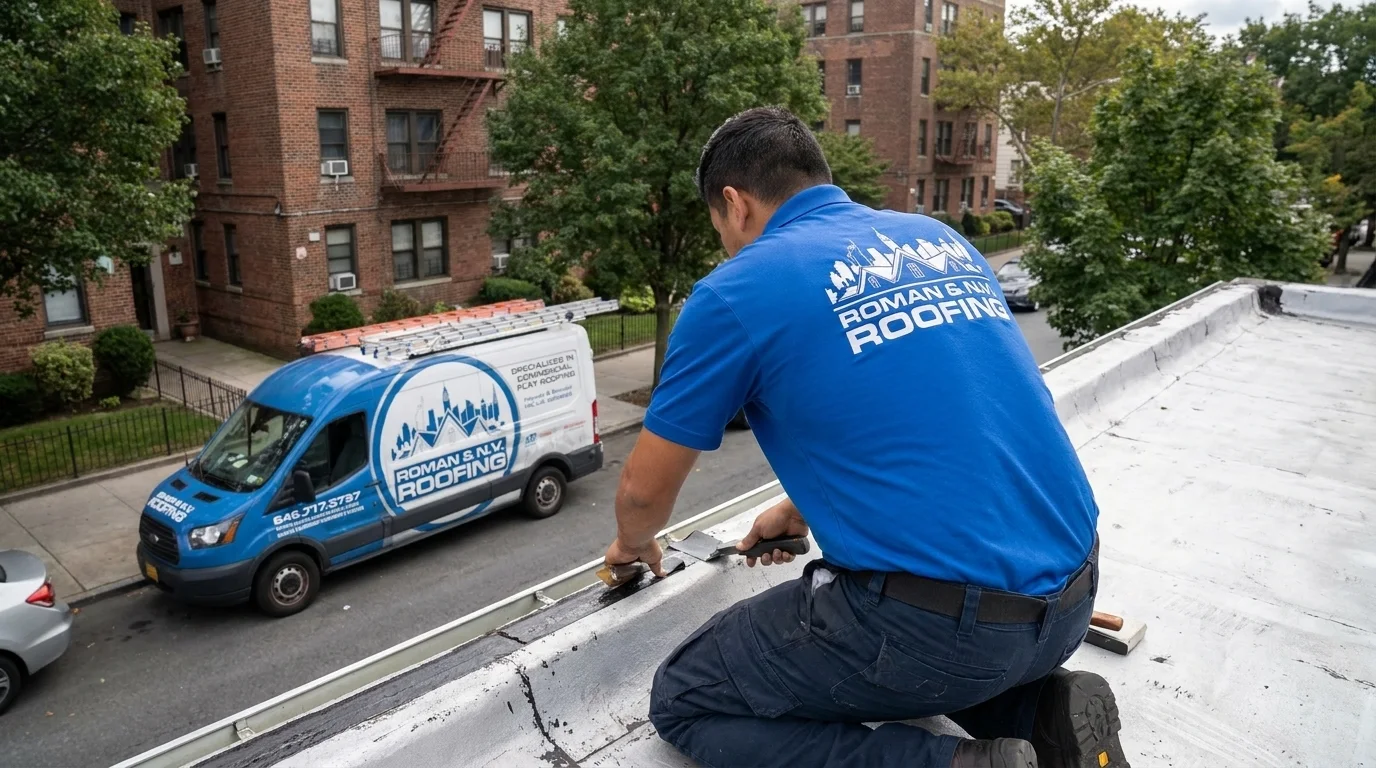
We start with a roof walk, not a drive-by estimate, because the condition of parapets, drains, and flashing details can’t be judged from the ground on most Manhattan buildings. From there we document the membrane type, check for soft spots or trapped moisture, and look at how the roof ties into adjoining structures, which matters on row buildings where one owner’s repair can affect a neighbor’s drainage path. Access is often the bigger logistical question in dense blocks near Chelsea or Tribeca, where freight elevators, narrow stairwells, or a single roof bulkhead are the only way to get materials up. We plan material staging and crew scheduling around that access point before work starts, not after, so the job doesn’t stall halfway through because a hoist or elevator reservation fell through.
Once the scope is set, repair or replacement work follows manufacturer specification for the membrane system in use, whether that’s a modified bitumen roof common on older walk-ups or a single-ply system on a more recently re-roofed building. Flashing details around bulkheads, parapet caps, and roof penetrations get rebuilt to shed water correctly rather than just resealed, since a quick seal on a bad detail tends to fail again within a season.
New York Insurance & HOA Coordination
Co-op and condo boards across Manhattan typically require their own sign-off before roof work begins, and many buildings near Midtown and the Financial District carry specific insurance documentation requirements tied to the building’s master policy. We work directly with building management and board representatives to provide certificates of insurance and scope documentation ahead of the work, which tends to be the step that slows a project down if it isn’t handled early. For buildings filing an insurance claim related to storm or wind damage, we document existing roof conditions and damage extent in a way adjusters can use, though the claim decision itself stays between the owner and their carrier.
Local note
One detail that catches building owners off guard: a lot of pre-war Manhattan roofs have parapet walls built from the same masonry as the facade, and that masonry absorbs and releases moisture differently than the roof membrane next to it. When we rebuild flashing at the parapet-to-roof joint, we account for that movement separately from the membrane work, because treating the two as one surface is a common reason flashing fails again within a year or two on buildings near the Lower East Side and similar older blocks.
If your building’s roof near the Empire State Building corridor, Chelsea, or anywhere else in Manhattan is showing ponding, cracked flashing, or a membrane past its expected service life, Roman NV Roofing can walk the roof and lay out what repair or replacement actually involves before you commit to either. Call (917) 440-1800 to schedule a look.
Serving New York from our New York office · ★ 5.0 · 168 Google reviews
“Storm damage left part of our Brooklyn roof in poor condition. Billy from Roman Local Law 11 NYC Restoration explained what needed to be addressed. The repair team worked carefully and restored the affected area.” — Sonia, October 2026Read our reviews on Google →
Commercial Roofing in New York: Service Coverage
Frequently Asked Questions
Do pre-war buildings in Chelsea or Tribeca need a different commercial roofing approach than newer construction?
Does my co-op or condo board need to approve commercial roofing work in Manhattan?
What roofing materials do you use for flat commercial roofs in New York?
How do you handle material access for commercial roofing on dense blocks like the Lower East Side?
Why does ponding water keep coming back on my building's roof near 10013 or similar older zip codes?
Commercial Roofing in New York
Our crews are based in New York, NY and take on projects across New York. Call for a free estimate.